|
Description
|
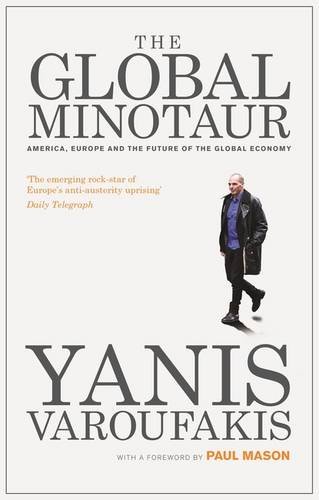
The emerging rock-star of Europe's anti-austerity uprising.' Daily Telegraph 'A spirited book.' New Yorker In this remar...
The emerging rock-star of Europe's anti-austerity uprising.' Daily Telegraph 'A spirited book.' New Yorker In this remarkable and provocative book, Yanis Varoufakis, former finance minister of Greece, explodes the myth that financialisation, ineffectual regulation of banks, greed and globalisation were the root causes of both the Eurozone crisis and the global economic crisis. Rather, they are symptoms of a much deeper malaise which can be traced all the way back to the Great Crash of 1929, then on through to the 1970s: the time when a Global Minotaur was born. Today's deepening crisis in Europe is just one of the inevitable symptoms of the weakening Minotaur; of a global system which is now as unsustainable as it is imbalanced. Going beyond this, Varoufakis reveals how we might reintroduce a modicum of reason into what has become a perniciously irrational economic order. An essential account of the socio-economic events and hidden histories that have shaped the world as we now know it. Author: Yanis Varoufakis ISBN:9781780324500
Read more
Show less
|
This devastating and inspiring book, by one of the world's leading economic thinkers, lays out not only the course of th...
This devastating and inspiring book, by one of the world's leading economic thinkers, lays out not only the course of the financial crisis which began in 2007, but its underlying causes, and shows why much more radical reforms are needed than are currently being contemplated if we are to avoid similar 'systemic' crises in the future. It shows why the bailout has been only marginally effective and how it could have been much more so, and outlines the enormous opportunity - not yet taken - to design a new global financial architecture. It is highly critical of many of the actions not only of George Bush's administration, but also of Barack Obama's. It shows why the bulk of the cost of recovery should be borne by those in the financial sector - not just for reasons of natural justice, but for compelling economic reasons also. More than any of this, it reminds readers to think constantly about what economies are for, and the human purposes they serve. Freefall is an instant classic, combining an enthralling whodunit account of the current crisis with a bracing discussion of the broader economic issues at stake. About the Author: Joseph Stiglitz Joseph Stiglitz was Chief Economist at the World Bank until January 2000. He is currently University Professor of the Columbia Business School and Chair of the Management Board and Director of Graduate Summer Programs, Brooks World Poverty Institute, University of Manchester. He won the Nobel Prize for Economics in 2001 and is the author of the best-selling Globalization and Its Discontents, The Roaring Nineties, and Making Globalization Work. Author: Joseph Stiglitz ISBN:9780141045122
Read more
Show less
|
Throughout the Western world, governments and financial elites responded to the financial crisis of 2008 by trying to re...
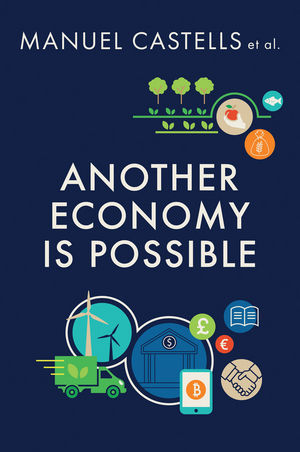
Throughout the Western world, governments and financial elites responded to the financial crisis of 2008 by trying to restore the conditions of business as usual, but the economic, social and human damage inflicted by the crisis has given rise to a reconsideration of the inevitability of unfettered capitalism as a fact of life. A number of economic practices and organizations emerged in Europe and the United States that embodied alternative values: the value of life over the value of money; the effectiveness of cooperation over cut-throat competition; the social responsibility of corporations and responsible regulation by governments over the short-term speculative strategies that brought the economy to the brink of catastrophe. This book examines the blossoming of innovative new experiments in organizing work and life that emerged in the wake of the financial crisis: cooperatives, barter networks, ethical banking, community currencies, shared time banks, solidarity networks, sharing of goods, non-monetary transactions, etc., experiments that paved the way for the emergence of a sharing economy in all domains of activity oriented toward the satisfaction of human needs. Other innovations included the creation of cryptographic virtual currencies, epitomized by bitcoin, which blended a libertarian, entrepreneurial spirit with information technology to provide an alternative to standard forms of currency. On the basis of a cross-cultural analysis of alternative economic practices, this book develops an important theoretical argument: that the economy, as a human practice, is shaped by culture, and that the diversity of cultures, as revealed in a time of crisis, implies the possibility of different economies depending on the values and power relations that define economic institutions. This book will be of great interest to students and scholars in sociology, economics and the social sciences generally, and to anyone who wishes to understand how our societies and economies are changing today. (less) Author: Manuel Castlells ISBN:9781509517213
Read more
Show less
|
On 9 August 2007 France's largest bank announced that it had had to suspend trading in two huge investment funds it cont...
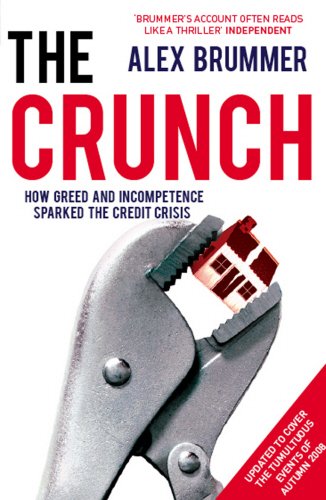
On 9 August 2007 France's largest bank announced that it had had to suspend trading in two huge investment funds it controlled. The same day three German banks revealed that they were close to collapse. A few days later came the first run on a British bank since the 1860s as vast queues of worried investors besieged Northern Rock. Within weeks, the Government were being forced to bail out this previously little-known bank to the tune of £30 billion, share prices in other mortgage lenders were plummeting, and alarming news about the state of several of the biggest US banks was crossing the Atlantic. What lay behind this series of crippling disasters? In The Crunch, award-winning journalist Alex Brummer painstakingly traces the course of the crisis from its origins in the US 'subprime' market to its explosion on to the international scene. It's a story of greed, mismanagement and dithering in which bankers seeking to make a quick buck, regulators engaged in turf wars and blame-avoidance, and governments paralysed by the sheer scale of the problem all conspired to bring the banking system almost to its knees. It's also a story of victims: the millions of people in the US who have already been thrown out of their houses, the entire population of the UK who have been co-opted to guarantee Northern Rock with £30 billion of public money, borrowers everywhere who are now finding credit more expensive and harder to get. And, as Alex Brummer convincingly argues, now that recession looms, this is only the beginning. Author: Alex Brummer ISBN:9781847940094
Read more
Show less
|