|
Description
|
ECONOMIST, FINANCIAL TIMES and EVENING STANDARD BOOKS OF THE YEAR 2015 Shortlisted for the Financial Times and McKinsey...
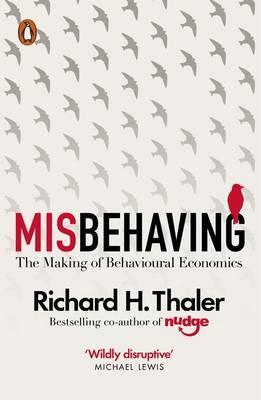
ECONOMIST, FINANCIAL TIMES and EVENING STANDARD BOOKS OF THE YEAR 2015 Shortlisted for the Financial Times and McKinsey Business Book of the Year Award From the renowned and entertaining behavioural economist and co-author of the seminal work Nudge, Misbehaving is an irreverent and enlightening look into human foibles. Traditional economics assumes that rational forces shape everything. Behavioural economics knows better. Richard Thaler has spent his career studying the notion that humans are central to the economy - and that we're error-prone individuals, not Spock-like automatons. Now behavioural economics is hugely influential, changing the way we think not just about money, but about ourselves, our world and all kinds of everyday decisions. Whether buying an alarm clock, selling football tickets, or applying for a mortgage, we all succumb to biases and make decisions that deviate from the standards of rationality assumed by economists. In other words, we misbehave. Dismissed at first by economists as an amusing sideshow, the study of human miscalculations and their effects on markets now drives efforts to make better decisions in our lives, our businesses, and our governments. Coupling recent discoveries in human psychology with a practical understanding of incentives and market behaviour, Thaler enlightens readers about how to make smarter decisions in an increasingly mystifying world. He reveals how behavioural economic analysis opens up new ways to look at everything from household finance to assigning faculty offices in a new building, to TV quiz shows, sports transfer seasons, and businesses like Uber. When economics meets psychology, the implications for individuals, managers and policy makers are both profound and entertaining. Author: Richard H. Thaler ISBN:9780241951224
Read more
Show less
|
Which is more dangerous, a gun or a swimming pool? What do schoolteachers and sumo wrestlers have in common? Why do drug...
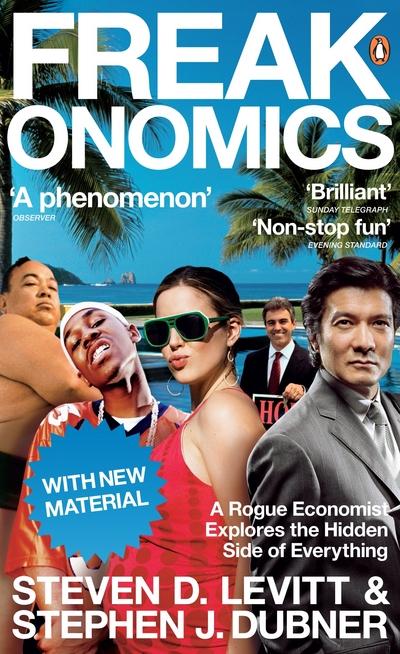
Which is more dangerous, a gun or a swimming pool? What do schoolteachers and sumo wrestlers have in common? Why do drug dealers still live with their moms? How much do parents really matter? What kind of impact did Roe v. Wade have on violent crime? Freakonomics will literally redefine the way we view the modern world. These may not sound like typical questions for an economist to ask. But Steven D. Levitt is not a typical economist. He is a much heralded scholar who studies the stuff and riddles of everyday life -- from cheating and crime to sports and child rearing -- and whose conclusions regularly turn the conventional wisdom on its head. He usually begins with a mountain of data and a simple, unasked question. Some of these questions concern life-and-death issues; others have an admittedly freakish quality. Thus the new field of study contained in this book: freakonomics. Through forceful storytelling and wry insight, Levitt and co-author Stephen J. Dubner show that economics is, at root, the study of incentives -- how people get what they want, or need, especially when other people want or need the same thing. In Freakonomics, they set out to explore the hidden side of ... well, everything. The inner workings of a crack gang. The truth about real-estate agents. The myths of campaign finance. The telltale marks of a cheating schoolteacher. The secrets of the Ku Klux Klan. What unites all these stories is a belief that the modern world, despite a surfeit of obfuscation, complication, and downright deceit, is not impenetrable, is not unknowable, and -- if the right questions are asked -- is even more intriguing than we think. All it takes is a new way of looking. Steven Levitt, through devilishly clever and clear-eyed thinking, shows how to see through all the clutter. Freakonomics establishes this unconventional premise: If morality represents how we would like the world to work, then economics represents how it actually does work. It is true that readers of this book will be armed with enough riddles and stories to last a thousand cocktail parties. But Freakonomics can provide more than that. It will literally redefine the way we view the modern world. Author: Steven D. Levitt, Stephen J. Dubner ISBN:9780141030081
Read more
Show less
|
From the bestselling author of A Beautiful Mind, a brilliant new approach to the story of modern economics and to unders...
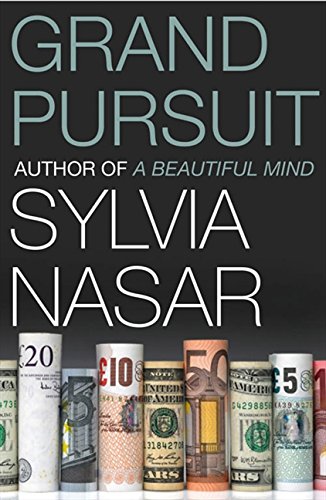
From the bestselling author of A Beautiful Mind, a brilliant new approach to the story of modern economics and to understanding how we got into today’s financial mess. As the twenty-first century faces new and ever more daunting economic obstacles, Sylvia Nasar tells the story of how our financial world came to function as it does today, and how a handful of men and women would change the lives of every person on the planet. Economics was not always associated with bankers and excess, or with recessions and bailouts. Economics, as we know it, was born in the nineteenth century when Charles Dickens and Henry Mayhew chronicled the destitution in London’s slums and wanted to turn money into a force for social good. Man’s material fate would be placed in his own hands, rather than left to destiny. The torch would be carried on by everyone from Marx and Engels to Keynes and Friedman, with revolutionary results. Filled with the stories of colourful lives and visions of the characters who shaped modern economics, Grand Pursuit is a fascinating history of the determining force of the past century, and a vital insight into how our world works now. ‘A history of economics which is full of flesh, bloom and warmth’ The Economist Author: Slyvia Nasar ISBN:9781841154565
Read more
Show less
|
The New York Times bestselling Freakonomics changed the way we see the world, exposing the hidden side of just about eve...
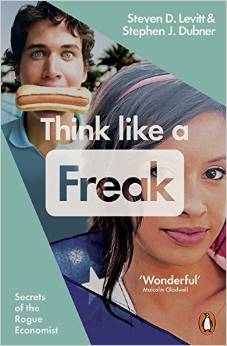
The New York Times bestselling Freakonomics changed the way we see the world, exposing the hidden side of just about everything. Then came SuperFreakonomics, a documentary film, an award-winning podcast, and more. Now, with Think Like a Freak, Steven D. Levitt and Stephen J. Dubner have written their most revolutionary book yet. With their trademark blend of captivating storytelling and unconventional analysis, they take us inside their thought process and teach us all to think a bit more productively, more creatively, more rationally—to think, that is, like a Freak. Levitt and Dubner offer a blueprint for an entirely new way to solve problems, whether your interest lies in minor lifehacks or major global reforms. As always, no topic is off-limits. They range from business to philanthropy to sports to politics, all with the goal of retraining your brain. Along the way, you’ll learn the secrets of a Japanese hot-dog-eating champion, the reason an Australian doctor swallowed a batch of dangerous bacteria, and why Nigerian e-mail scammers make a point of saying they’re from Nigeria. Some of the steps toward thinking like a Freak: First, put away your moral compass—because it’s hard to see a problem clearly if you’ve already decided what to do about it. Learn to say “I don’t know”—for until you can admit what you don’t yet know, it’s virtually impossible to learn what you need to. Think like a child—because you’ll come up with better ideas and ask better questions. Take a master class in incentives—because for better or worse, incentives rule our world. Learn to persuade people who don’t want to be persuaded—because being right is rarely enough to carry the day. Learn to appreciate the upside of quitting—because you can’t solve tomorrow’s problem if you aren’t willing to abandon today’s dud. Levitt and Dubner plainly see the world like no one else. Now you can too. Never before have such iconoclastic thinkers been so revealing—and so much fun to read. Author: Steven D. Levitt ISBN:9780141980119
Read more
Show less
|