|
Description
|
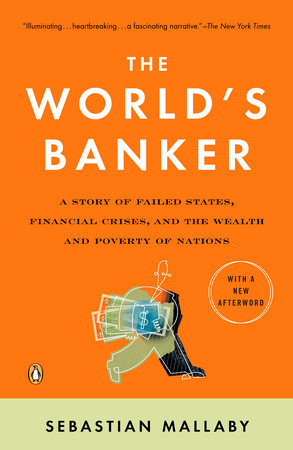
Never has the World Bank’s relief work been more important than in the last nine years, when crises as huge as AID...
Never has the World Bank’s relief work been more important than in the last nine years, when crises as huge as AIDS and the emergence of terrorist sanctuaries have threatened the prosperity of billions. This journalistic masterpiece by Washington Post columnist Sebastian Mallaby charts those controversial years at the Bank under the leadership of James Wolfensohn—the unstoppable power broker whose daring efforts to enlarge the planet’s wealth in an age of globalization and terror were matched only by the force of his polarizing personality. Based on unprecedented access to its subject, this captivating tour through the messy reality of global development is that rare triumph—an emblematic story through which a gifted author has channeled the spirit of the age. This edition features a new afterword by the author that analyzes the appointment of Paul Wolfowitz as Wolfensohn’s successor at the World bank Author:Sebastian Mallaby ISBN:9780143036791
Read more
Show less
|
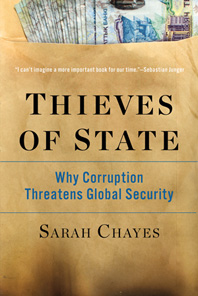
Winner of the 2015 Los Angeles Times Book Prize for Current Interest. "I can’t imagine a more important book for o...
Winner of the 2015 Los Angeles Times Book Prize for Current Interest. "I can’t imagine a more important book for our time." —Sebastian Junger The world is blowing up. Every day a new blaze seems to ignite: the bloody implosion of Iraq and Syria; the East-West standoff in Ukraine; abducted schoolgirls in Nigeria. Is there some thread tying these frightening international security crises together? In a riveting account that weaves history with fast-moving reportage and insider accounts from the Afghanistan war, Sarah Chayes identifies the unexpected link: corruption. Since the late 1990s, corruption has reached such an extent that some governments resemble glorified criminal gangs, bent solely on their own enrichment. These kleptocrats drive indignant populations to extremes—ranging from revolution to militant puritanical religion. Chayes plunges readers into some of the most venal environments on earth and examines what emerges: Afghans returning to the Taliban, Egyptians overthrowing the Mubarak government (but also redesigning Al-Qaeda), and Nigerians embracing both radical evangelical Christianity and the Islamist terror group Boko Haram. In many such places, rigid moral codes are put forth as an antidote to the collapse of public integrity. The pattern, moreover, pervades history. Through deep archival research, Chayes reveals that canonical political thinkers such as John Locke and Machiavelli, as well as the great medieval Islamic statesman Nizam al-Mulk, all named corruption as a threat to the realm. In a thrilling argument connecting the Protestant Reformation to the Arab Spring, Thieves of State presents a powerful new way to understand global extremism. And it makes a compelling case that we must confront corruption, for it is a cause—not a result—of global instability. Author: Sarah Chayes ISBN:9780393352283
Read more
Show less
|
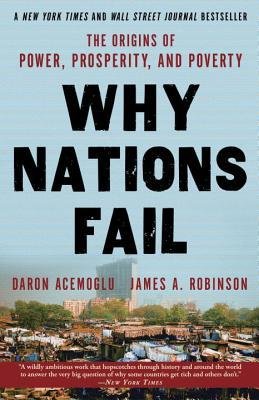
Is it culture, the weather, geography? Perhaps ignorance of what the right policies are? Simply, no. None of these facto...
Is it culture, the weather, geography? Perhaps ignorance of what the right policies are? Simply, no. None of these factors is either definitive or destiny. Otherwise, how to explain why Botswana has become one of the fastest growing countries in the world, while other African nations, such as Zimbabwe, the Congo, and Sierra Leone, are mired in poverty and violence? Daron Acemoglu and James Robinson conclusively show that it is man-made political and economic institutions that underlie economic success (or lack of it). Korea, to take just one of their fascinating examples, is a remarkably homogeneous nation, yet the people of North Korea are among the poorest on earth while their brothers and sisters in South Korea are among the richest. The south forged a society that created incentives, rewarded innovation, and allowed everyone to participate in economic opportunities. The economic success thus spurred was sustained because the government became accountable and responsive to citizens and the great mass of people. Sadly, the people of the north have endured decades of famine, political repression, and very different economic institutions—with no end in sight. The differences between the Koreas is due to the politics that created these completely different institutional trajectories. Based on fifteen years of original research Acemoglu and Robinson marshall extraordinary historical evidence from the Roman Empire, the Mayan city-states, medieval Venice, the Soviet Union, Latin America, England, Europe, the United States, and Africa to build a new theory of political economy with great relevance for the big questions of today, including: – China has built an authoritarian growth machine. Will it continue to grow at such high speed and overwhelm the West? – Are America’s best days behind it? Are we moving from a virtuous circle in which efforts by elites to aggrandize power are resisted to a vicious one that enriches and empowers a small minority? – What is the most effective way to help move billions of people from the rut of poverty to prosperity? More philanthropy from the wealthy nations of the West? Or learning the hard-won lessons of Acemoglu and Robinson’s breakthrough ideas on the interplay between inclusive political and economic institutions?
Read more
Show less
|
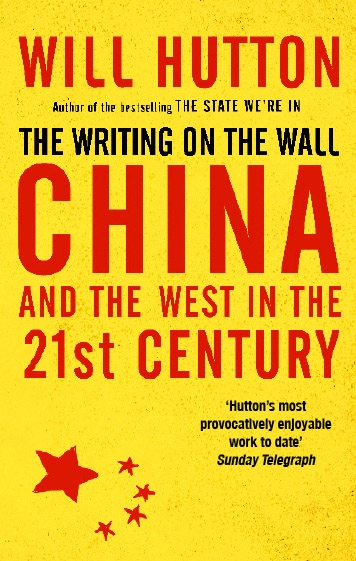
An incisive and thoroughly accessible account of China's emergence as an economic power and its developing relationship...
An incisive and thoroughly accessible account of China's emergence as an economic power and its developing relationship with the West China constitutes a fifth of the world's population. Over the last twenty years its economy has doubled to make it the fifth largest economy in the world; if the pace is repeated over the next twenty it is set to become second only to the US. The speed of its development is stunning, a combination of cheap labour and commitment to science and technology that has never been matched by a developing country. The Pearl River Delta, Shanghai and Beijing have become city-regions whose growth and embrace of modernity strike the visitor with awesome force. This is a continent on the move, recovering the world position and wealth it once had. The re-emergence of China as a superpower constitutes the biggest challenge the world has had for more than a century. Never before in modern times has the financial, trade, economic and diplomatic world pecking order been so profoundly reconstituted with the challenger country itself in the grips of incredible ideological and political change. This is a transition both internally in China and externally in the world beyond beset by hazard and risk. The world's peace and prosperity depends upon it being executed successfully. Author:Will Hutton ISBN:9780349118826
Read more
Show less
|